LinkedIn audiences come with a clear goal, so relevance matters most. Therefore, you should choose your format during planning, not at the last minute while designing. Additionally, you should match what people want to know with how much information each format can share. As a result, this guide explains linkedin ad formats in a simple, campaign-ready way.
Pick the Goal, Then the Format
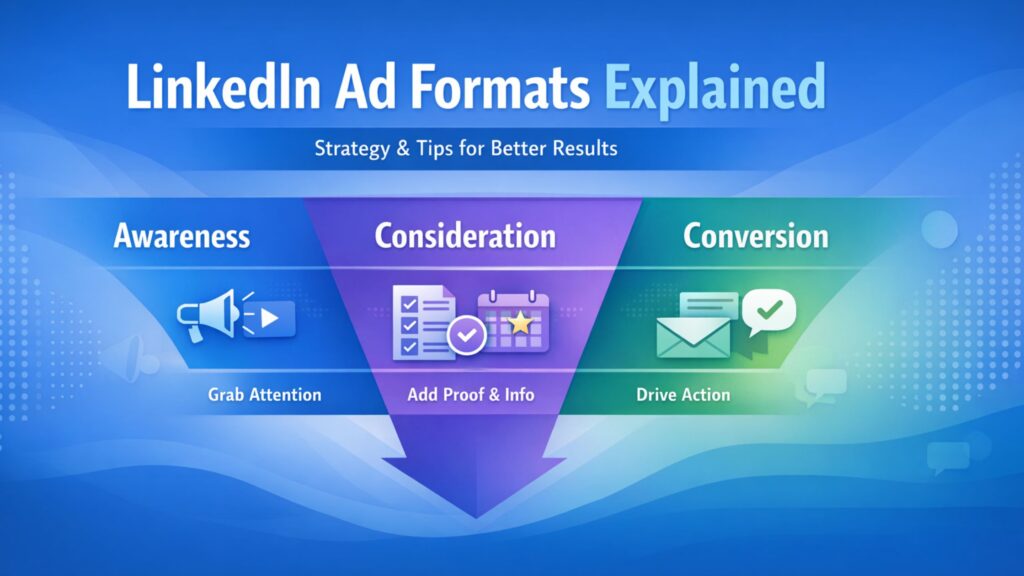
You get better results when you pick one main goal first. For example, you may want awareness, engagement, website clicks, or lead capture. Moreover, a clear goal makes approvals easier and helps you launch faster. Then you should choose the format that drives that action with the fewest steps. Additionally, you should decide whether the buyer needs proof, quick education, or a direct prompt. As a result, you align the creative, the copy, and the next step from day one, and you waste less time testing.
Attention-Winning Feed Ads
The feed drives discovery, so most teams start here. Therefore, you should focus on one result and one clear next step. Additionally, you should make sure the visual promise matches the headline promise.
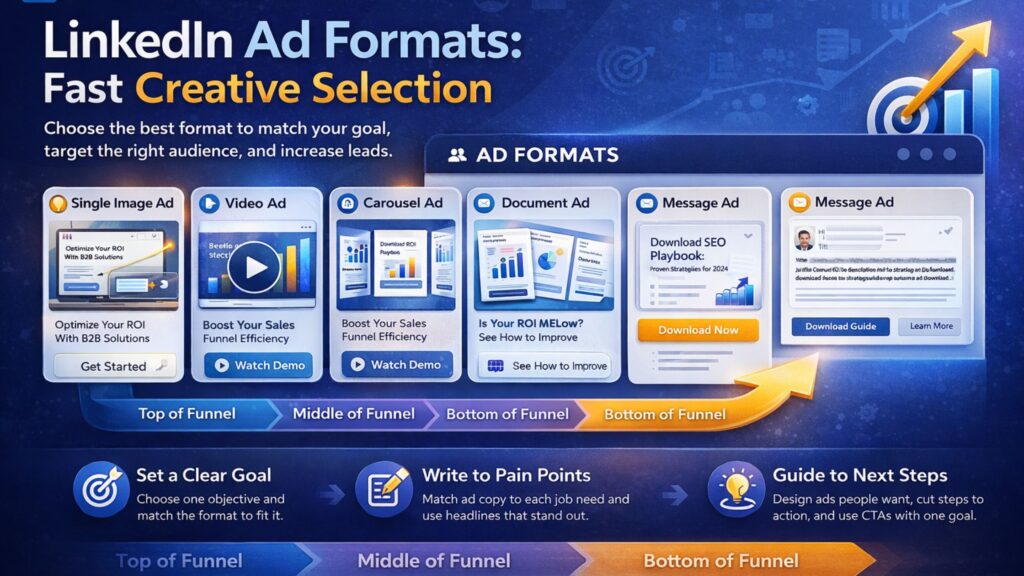
A. Single Image Ads
Single images share the message fast. Therefore, you should stick to one strong visual idea, one headline, and one CTA. Additionally, you should use this format for quick testing, because you can swap hooks often. Still, you should keep the copy short, because long text can bury the point.
B. Video Ads
Video builds trust when you show proof or process. Therefore, you should open with the benefit in the first few seconds. Additionally, you should add captions, because many people scroll with sound off. Then you should follow a simple flow: hook, proof, offer, next step. Consequently, video explains one strong use case without forcing people to read heavy text.
C. Carousel Ads
Carousels help you teach in steps. Therefore, you can use a clean sequence like “problem → impact → solution → proof → CTA” across cards. Additionally, you should make each card clear on its own, because people may swipe fast. As a result, you hold attention while adding depth.
D. Document Ads
Documents work like a mini guide inside LinkedIn. Therefore, you should use checklists, frameworks, or short playbooks. Additionally, you should design a strong cover, because the cover drives opens. Then you should keep pages easy to scan with headings and bullets, so the reader feels progress quickly.
E. Event and Content Promotion
Event ads support sign-ups and reminders. Therefore, you should say who the event helps and what the attendee will learn. Additionally, you should run follow-up ads with the same promise, because repetition increases turnout. You can also promote thought-leader posts, articles, or newsletters. Consequently, you teach first and build trust before asking for action.
As a result, when you match each feed format to one clear promise and one simple next step, you turn attention into steady, trackable action.
Direct-Response Message Formats
Message placements feel personal, so you have to earn the click. Therefore, you should target the right people and write like a real person, not a brochure. Additionally, you should share the benefit early, because vague messages get ignored fast.
i. Message Ads
Message ads send one clear note with one main CTA. Therefore, you should use them for invites, quick follow-ups, and high-intent offers. Additionally, you should keep the message short and place the value in the first lines.
ii. Conversation Ads
Conversation ads add buttons and choices, so they work well for qualification. Therefore, you should guide people based on real intent, such as role, goal, or industry. However, you should keep choices limited, because too many options slow decisions. As a result, you keep the flow moving and you capture cleaner intent signals.
As a result, when you keep the message human, the offer clear, and the choices limited, message placements drive replies that actually move leads forward.
Ad Formats by Funnel Stage
You should choose formats based on how warm the audience is. Therefore, you can follow this simple map:
a) Top of funnel: Use single image, video, carousel, and thought-leader promotion, because they grab attention fast. Additionally, you should use industry-specific words, because generic copy gets ignored.
b) Middle of funnel: Use document ads, carousels, and event promotion, because they add more detail. Moreover, you should include proof and simple comparisons, because buyers start checking risk here.
c) Bottom of funnel: Use message ads, conversation ads, and direct-response feed ads, because they drive the final action. Additionally, you should tighten the CTA and remove distractions, because warm audiences want clarity and certainty.
As a result, when you match the format to audience temperature, you guide people smoothly from first attention to confident action. Learn more about LinkedIn Ads Cost.
Creative Rules That Work
You can improve results across linkedin ad formats when you follow the same simple rules every time. Therefore, you should use a repeatable checklist before you launch any campaign.
Additionally, you should keep one clear claim per ad, so the audience understands the point in seconds. Moreover, you should place proof early—a quick result, a screenshot, or a short quote—because LinkedIn users scroll fast and trust what they can verify. Consequently, you should build clean visual hierarchy with one focal message, readable text, and an obvious CTA, so the eye lands on the right idea immediately.
Meanwhile, you should refresh creatives on a schedule, because even strong ads lose impact when the same people see them too often. Finally, you should test one variable at a time—headline, visual, offer, or CTA—so you can identify real winners and scale them with confidence.
Conclusion
Therefore, you get better results when you choose linkedin ad formats based on your objective, funnel stage, and the assets you have. Additionally, you reduce wasted spend when you design the message to fit the format instead of forcing the format to tell the wrong story. For brands that want results-driven strategy and execution,MobileRad delivers integrated LinkedIn advertising alongside geofencing, OTT/CTV campaigns, SEO, email marketing, and content creation—so every channel works together to drive measurable growth.

Ranjan Barman
Ranjan Barman is a digital marketing writer and contributor for MobileRad, covering programmatic, video, display, OTT/CTV, and retargeting advertising for small businesses.