
Email marketing for customer acquisition is the practice of using targeted email campaigns to attract prospects, nurture their interest, and convert them into paying customers. It typically involves list-building tactics like lead magnets, opt-in forms, and referral programs, followed by automated nurture sequences designed to move subscribers through the purchase decision. Unlike retention email marketing, which focuses on repeat purchases and loyalty, acquisition email marketing targets people who have never bought from you before.

Why Email Still Dominates Customer Acquisition in 2026
Skeptics often ask whether email can compete with social ads and influencer marketing. The numbers answer that question clearly. Email marketing delivers between $36 and $42 for every $1 spent, making it the highest-ROI digital channel available to most marketing budgets. According to Zeta Global, email consistently outperforms paid search and social when measured by cost-per-conversion across acquisition campaigns.
Email also reaches an audience that has already signaled interest. A subscriber who opts in is warmer than a social media user served a cold ad. That permission-based relationship is why acquisition email campaigns convert at 2–5% on average, while display ads rarely break 1%. For marketing professionals managing tight budgets, email is not a legacy channel — it is a compounding asset.
The Acquisition Funnel Email Marketers Must Understand
Effective email marketing for customer acquisition maps specific campaign types to three funnel stages: awareness, consideration, and conversion. Sending the wrong email at the wrong stage wastes budget and trains subscribers to ignore you. Understanding lifecycle email marketing means treating each stage as a distinct job with distinct success metrics.
Awareness Stage: Getting Into the Right Inboxes
At the awareness stage, your goal is volume — getting your brand in front of qualified prospects who don’t know you yet. Co-registration partnerships let you appear on third-party opt-in forms alongside complementary brands, delivering warm leads at a cost-per-lead (CPL) typically between $1 and $5. Platforms like Deep Sync specialize in third-party email acquisition, connecting brands with permission-based audience data at scale.
Paid social-to-email capture is another high-performing awareness tactic. Running a Meta or LinkedIn lead-generation ad that feeds directly into your email automation platform can yield CPLs between $3 and $15, depending on your industry and targeting precision. The key is driving traffic to a dedicated landing page with a single opt-in form — not your homepage.
Consideration Stage: Lead Magnets and Content Upgrades That Convert
A lead magnet is the incentive you offer in exchange for an email address. Not all lead magnets perform equally. Generic PDF guides convert at roughly 1–3%, while interactive tools, data reports, and content upgrades tied to specific blog posts convert at 5–15%, according to industry benchmarks tracked by platforms like Mailercloud.
Content upgrades — downloadable assets that extend a specific piece of content — outperform standalone lead magnets because they match intent precisely. A visitor reading your article on pricing strategy is more likely to download a pricing calculator than a general “marketing guide.” Templates and checklists also outperform long-form PDFs because they deliver immediate utility. Prioritize formats that solve a specific problem in under five minutes.
Conversion Stage: Offer Sequencing That Closes New Customers
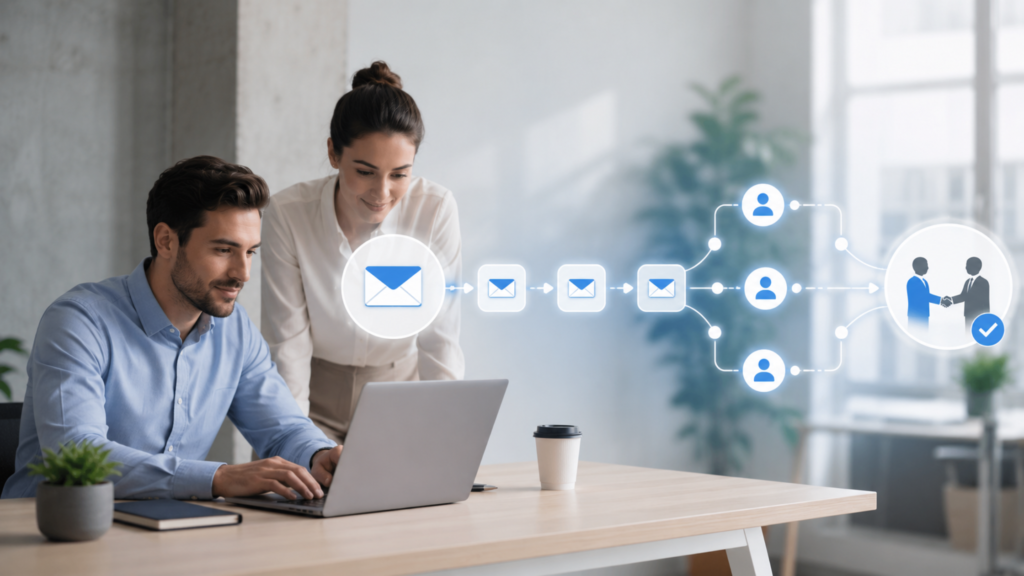
A welcome email sequence is your highest-leverage conversion tool. New subscribers are most engaged within the first 48 hours — open rates for welcome emails average 50–60%, roughly four times higher than standard campaigns. A 3-to-5 email sequence structured as follows consistently outperforms single-send approaches:
- Email 1 (Immediate): Deliver the lead magnet, set expectations, introduce your brand value proposition.
- Email 2 (Day 2): Share a customer success story or social proof tied to the subscriber’s stated interest.
- Email 3 (Day 4): Present a soft offer — free shipping, a limited discount, or a free trial — with a clear call-to-action (CTA).
- Email 4 (Day 7): Address the most common objection your prospects face before buying.
- Email 5 (Day 10): Create urgency by expiring the offer introduced in Email 3.
Personalization logic matters here. If a subscriber clicked a link about Product Category A in Email 2, Email 3 should feature that category — not a generic offer. Email automation platforms like Klaviyo, ActiveCampaign, and HubSpot make this behavioral branching straightforward to implement.
List-Building Tactics Ranked by Cost-Per-Acquisition
Most guides list tactics without helping you prioritize. Below is a ranked framework by estimated CPA, moving from lowest to highest cost:
| Tactic | Estimated CPA | Notes |
|---|---|---|
| Organic opt-in forms (blog, homepage) | $0–$5 | Lowest cost; requires traffic |
| Content upgrades / lead magnets | $2–$10 | Scales with content investment |
| Referral incentive programs | $5–$15 | Leverages existing subscriber base |
| Contest and giveaway campaigns | $5–$20 | High volume; lower intent |
| Co-registration (via Deep Sync) | $3–$12 | Scalable; vet list quality |
| Paid social-to-email capture | $10–$40 | Fastest scale; highest cost |
Referral incentives deserve more attention than most brands give them. Offering existing subscribers a discount or exclusive access in exchange for referring a friend produces leads with above-average lifetime value because they arrive with social proof already attached. Emma’s research on acquisition best practices identifies referral programs as one of the most underused tactics in email list building.
Prioritize organic opt-in forms and content upgrades first. Once those systems are in place, layer in paid social capture to accelerate growth without abandoning the low-CPA foundation.
Segmentation and Personalization: From Prospect to Paying Customer
Segmentation is the practice of dividing your email list into groups based on shared characteristics or behaviors. For cold acquisition lists, behavioral segmentation — based on clicks, page visits, and engagement — accelerates conversion faster than demographic segmentation alone. Review your email segmentation best practices to build a schema that scales.
A practical acquisition segmentation schema looks like this:
- Segment A: Opened welcome email + clicked product link → send conversion offer within 24 hours
- Segment B: Opened welcome email + no click → send social proof email on Day 3
- Segment C: Did not open welcome email → resend with new subject line on Day 2, then move to re-engagement sequence
Cart abandonment triggers are also acquisition tools when a new visitor adds a product without purchasing. An automated three-email cart abandonment sequence — sent at 1 hour, 24 hours, and 72 hours — recovers an average of 5–10% of abandoned sessions, according to Triple Whale’s eCommerce lifecycle data. Including a free shipping offer in the second or third email meaningfully lifts recovery rates.
Key Metrics to Track Acquisition Email Performance
Acquisition campaigns require different benchmarks than retention campaigns. Retention audiences already know your brand; acquisition audiences do not. Use these benchmarks specific to acquisition:
- Open rate: 20–30% is healthy for a warmed acquisition list; below 15% signals deliverability or relevance issues.
- Click-to-open rate (CTOR): 10–15% indicates your content matches subscriber expectations. CTOR isolates offer performance from subject line performance.
- Conversion rate: 1–3% on a cold list is realistic for a first-purchase offer; 3–5% indicates strong offer-audience fit.
- Cost-per-acquisition (CPA): Industry averages range from $10 to $50 for email-driven first purchases, depending on product price point and sequence length. Lower-priced products typically see CPAs under $20.
Track these metrics at the sequence level, not just the individual email level. A sequence that converts at 4% overall is performing well even if Email 1 converts at 0%.

Common Mistakes That Kill Email Acquisition Campaigns
Poor deliverability is the single most damaging mistake. Sending to unverified or purchased lists tanks your sender reputation, which causes future emails — even to engaged subscribers — to land in spam. Always validate new addresses at the point of capture using tools like ZeroBounce or NeverBounce.
List hygiene failures compound over time. Remove subscribers who haven’t opened an email in 90 days from active acquisition sequences. Keeping unengaged contacts inflates your list size but deflates your open rates, which signals to inbox providers that your emails are unwanted.
Misaligned CTAs are the third most common failure point. Every acquisition email should have one primary CTA. Multiple competing links — “Shop now,” “Read our blog,” “Follow us on Instagram” — dilute click intent and reduce conversion rates. Match your CTA to the specific stage of the funnel the subscriber is in, not the action you most want them to take globally.
Quick-Start Action Plan: Your First 30 Days
Use this phased checklist to launch or restructure your email acquisition program:
Days 1–10: Infrastructure
- [ ] Audit and clean your existing email list
- [ ] Set up or verify your sending domain (SPF, DKIM, DMARC)
- [ ] Install opt-in forms on your top 5 traffic pages
- [ ] Select or create one high-converting lead magnet (template, tool, or data report)
- [ ] Build your 5-email welcome sequence in your email automation platform
Days 11–20: Traffic and List Building
- [ ] Launch one paid social-to-email capture campaign with a $500–$1,000 test budget
- [ ] Add a content upgrade to your highest-traffic blog post
- [ ] Set up a referral incentive for existing subscribers
- [ ] Configure behavioral segmentation triggers (click-based branching) in your automation
Days 21–30: Optimize and Scale
- [ ] Review open rate, CTOR, and CPA data from your welcome sequence
- [ ] A/B test subject lines on your highest-volume send
- [ ] Remove non-openers from active sequences and move them to a re-engagement flow
- [ ] Identify your lowest-CPA list-building tactic and double the investment
This 30-day plan builds the foundation, the traffic, and the optimization loop needed to make email marketing a reliable customer acquisition engine. Explore additional email list building strategies, high-converting lead magnet ideas, and welcome email sequence examples to continue scaling.
FAQs
1. What is email marketing for customer acquisition and how does it differ from retention email marketing?
Email marketing for customer acquisition uses email campaigns to attract new prospects and convert them into first-time customers. It focuses on list building, lead magnets, and nurture sequences for people unfamiliar with your brand. Retention email marketing, by contrast, targets existing customers with loyalty offers, upsells, and re-engagement campaigns. The audiences, messaging, and success metrics are fundamentally different.
2. What are the most effective lead magnet types for building an email list of new customers?
Interactive tools, templates, and original data reports consistently outperform generic PDF guides. These formats deliver immediate, specific value — a pricing calculator, a campaign planning template, or an industry benchmark report — which increases both opt-in rates (5–15%) and post-opt-in engagement. Avoid broad “ultimate guide” PDFs unless they contain genuinely proprietary data.
3. How many emails should be in a customer acquisition nurture sequence?
A 3-to-5 email welcome sequence is the proven standard for acquisition campaigns. Fewer than three emails leaves conversion potential on the table; more than five risks unsubscribes before a relationship is established. Structure the sequence to deliver value first, introduce a soft offer by Day 4, address objections by Day 7, and create urgency by Day 10.
4. What is a good cost-per-acquisition benchmark for email marketing campaigns?
A reasonable CPA benchmark for email-driven first purchases ranges from $10 to $50, depending on your product price point and acquisition channel mix. Organic list-building tactics (opt-in forms, content upgrades) typically produce CPAs under $10. Paid social-to-email capture campaigns generally run $15–$50 CPA. Review your email marketing ROI benchmarks to contextualize these numbers against your industry.
5. How do you segment a cold email list to improve conversion rates?
Start with behavioral segmentation based on email engagement: separate subscribers who clicked from those who only opened, and those who didn’t open at all. Send click-based subscribers a direct conversion offer within 24 hours. Send openers-only a social proof email. Re-send to non-openers with a new subject line before moving them to a re-engagement sequence. This three-segment schema alone can lift overall sequence conversion rates by 20–40%.
6. Is email marketing still effective for acquiring new customers compared to social ads and influencer marketing?
Yes. Email marketing returns $36–$42 per $1 spent, which outperforms paid social and influencer marketing on a cost-per-conversion basis for most industries. Social ads and influencer campaigns excel at top-of-funnel reach, but email converts that awareness into revenue more efficiently. The strongest acquisition programs combine paid social for list growth with email automation for conversion — treating the two channels as complementary, not competing.

Ranjan Barman
Ranjan Barman is the founder of MobileRad, helping small businesses across the United States grow through programmatic, video, display, OTT/CTV, and retargeting advertising.