B2B buyers ignore generic ads, while they respond to messages that match their role and priorities. Therefore, linkedin ad targeting helps you reach the right professionals with clear relevance, and it keeps your effort focused on people who can actually buy. Moreover, the platform’s work-first context increases intent because users scroll with a business mindset. In this guide, you will build audiences, align creative to pain points, and optimize campaigns with a repeatable process that combines linkedin audience targeting with disciplined testing.
Set a Clean Campaign Foundation
Before you change targeting filters, set a clean campaign base, because a strong structure makes LinkedIn easier to optimize and scale.
I. Pick one goal and one conversion
Choose one objective and one primary action. This keeps bidding, creative, and landing pages aligned. When you mix goals, you weaken signals for linkedin ad targeting and linkedin audience targeting.
II. Define your ideal buyer
List best-fit industries, company sizes, locations, and key titles. Add 2–3 pain points per role, so messaging stays specific and linkedin audience targeting stays accurate.
III. Match the offer to intent
Use low-commitment assets for cold audiences and high-intent offers for warm audiences. This improves conversion rate because the task fits readiness.
When you align one goal, the right buyer, and the right offer, you improve relevance, conversions, and lead quality.
Create High-Fit Audiences
Once your campaign goal stays clear, you should build audiences with precision, because the right filters put your message in front of the exact people who can act on it.
A. Start with job-based targeting
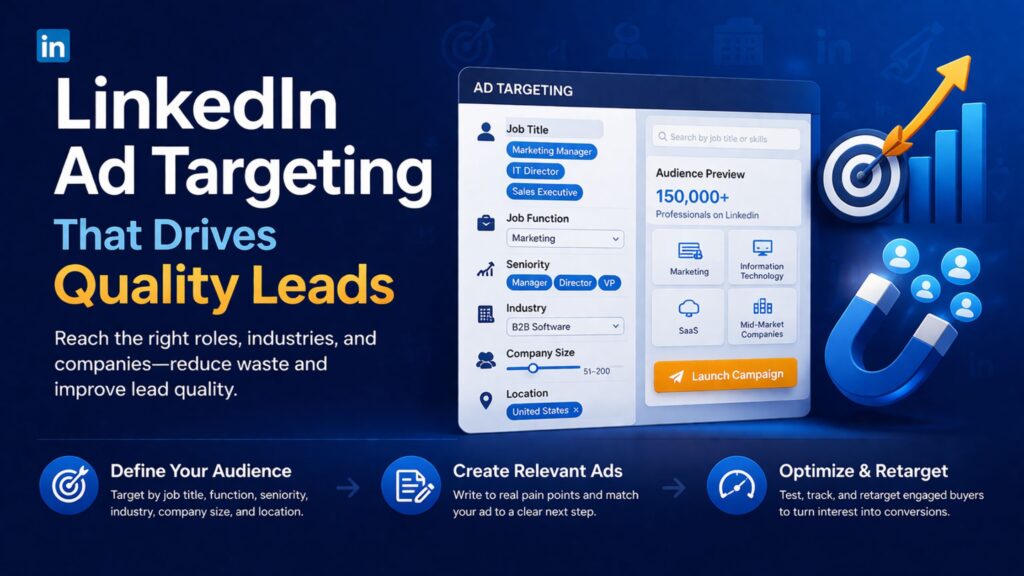
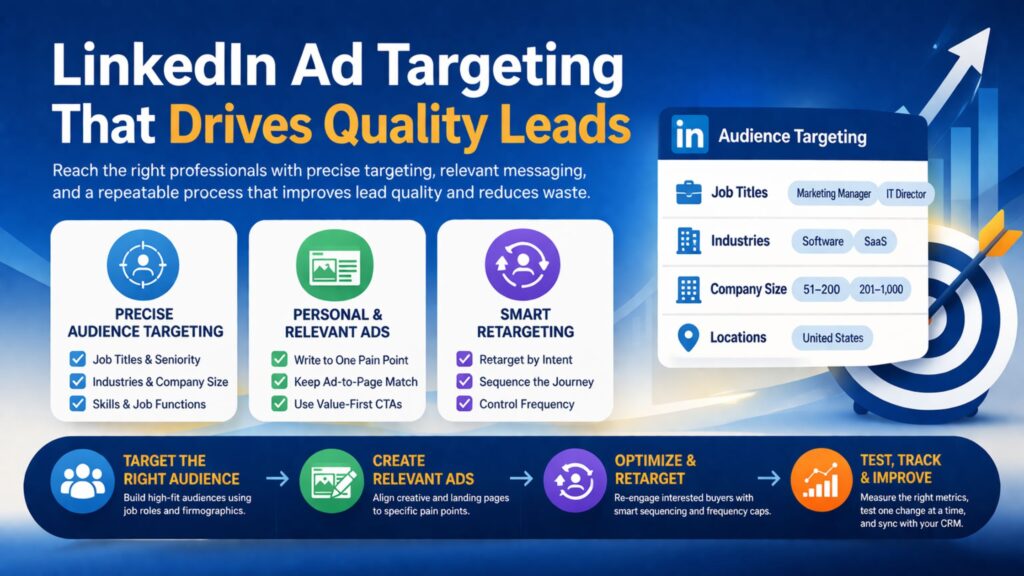
LinkedIn lets you target by job title, job function, seniority, skills, and groups. Consequently, linkedin ad targeting becomes role-specific, and linkedin audience targeting helps you speak directly to the responsibilities of the viewer. Additionally, you can split influencers from approvers, so you tailor proof and CTAs to each segment.
B. Add firmographics for fit
After you choose roles, narrow by industry, company size, and location. Moreover, you can keep quality high by excluding industries you do not serve or sizes that never convert. When you treat exclusions as strategy, linkedin audience targeting protects performance from wasted impressions.
C. Use audience tiers
Create three tiers: a tight core audience, a broader expansion audience, and a retargeting audience. Then, you compare lead quality across tiers and scale the best one. Therefore, you avoid guessing, and you scale with evidence.
When you combine role targeting, firmographic fit, and tiered audiences, you turn linkedin ad targeting and linkedin audience targeting into a controlled system that improves relevance, reduces waste, and scales results with clarity.
Create Personal, Relevant Ads
Once you lock the audience, your creative must earn attention fast, because relevance decides the scroll.
- Write to one pain point: Build separate themes for lead quality, pipeline speed, and brand authority, so each ad speaks to a real job need identified through linkedin audience targeting.
- Keep ad-to-page match: Repeat the same promise on the landing page, push one next step, and place proof close to the CTA to reduce drop-offs.
- Use value-first CTAs: Use action lines like “Download the guide” or “Watch the webinar,” and keep CTAs consistent across tests for cleaner insights.
When your ads stay focused, your page stays aligned, and your CTA stays valuable, linkedin ad targeting drives stronger clicks and higher-intent leads.
Bring Back Interested Buyers
Cold audiences rarely convert on the first touch, so retargeting helps you turn interest into action.
- Retarget by intent: Reach site visitors, video viewers, and engagers, then split them by behavior, such as pricing-page visits versus blog reads, and show the next best offer.
- Sequence the journey: Run awareness first, proof next, and conversion last, so trust builds before you ask for details.
- Control frequency: Limit repeat views and rotate hooks and visuals, so performance stays strong and your brand feels fresh.
When you segment smartly, sequence content, and manage exposure, linkedin ad targeting becomes a steady conversion system instead of a one-shot campaign.
Test, Track, Improve
Measure and test with discipline, because clean data drives clear decisions.
- Track the right metrics: For awareness, watch video completion and landing-page views. For leads, track form fills and lead quality. For pipeline, track meetings and opportunities.
- Test one change at a time: Adjust one variable, such as audience, offer, or headline, so results stay easy to explain and scale.
- Tag and sync with CRM: Use UTM tags on every ad and route source data into your CRM, so follow-up stays fast and consistent.
When you track outcomes, run focused tests, and connect UTMs to sales, linkedin ad targeting becomes predictable instead of trial-and-error. Learn more about LinkedIn Ads for B2B Marketing.
Turn Clicks Into Conversions
LinkedIn performs better when your website answers questions after the click. Therefore, publish SEO-driven pages, industry landing pages, and comparison content that reinforces your offer and expands linkedin audience targeting pools for retargeting. Additionally, run short email nurture sequences for “not yet” leads, because most buyers need multiple touches before they book. Finally, you can pair LinkedIn with video or streaming placements for broader reach, and then retarget engaged viewers on LinkedIn for conversions.
Common Mistakes to Avoid
Avoid overly broad audiences, because broad targeting invites low-fit clicks and weak relevance. Avoid copy that sounds like everyone else, because decision-makers ignore vague promises. Also avoid poor post-click experiences, because slow pages and long forms reduce conversions quickly. Instead, tighten linkedin audience targeting, lead with a clear outcome, show proof early, and keep the next step simple.

Conclusion
You can drive steady B2B growth when you run linkedin ad targeting as a system, not a one-off push. Set one goal, build clear audience tiers, create pain-point ads, and improve results with consistent testing. Moreover, performance grows faster when linkedin audience targeting connects with SEO content, email nurturing, and retargeting.
MobileRad supports this full-funnel approach with LinkedIn ads plus geofencing, OTT/CTV, SEO, email marketing, and content creation.